
11 Confirmed methods to increase the dwell time
Are you doing everything you can to rank for a specific keyword? Are you struggling to get to the first page, let alone the top?
Here's the thing: there's a good chance you're making a ton of mistakes that send users back to the SERP.
After developing hundreds of high ranking pages, I want to show you the role dwell time plays in ranking and how you can increase it.
Before I share 11 strategies for increasing your dwell time, let's look at what dwell time is and why it matters.
What is dwell time?
Dwell time is the time a user spends on your page before returning to SERP. Most SEOs consider dwell time to be a ranking signal, although Google hasn't confirmed it.
Let's say you want to set up a better morning routine. So you google "morning rituals".
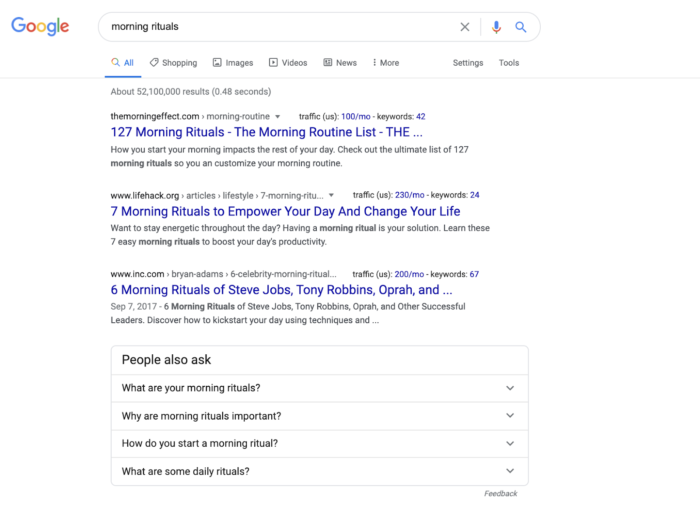
You click on the first result. However, the page is difficult to navigate and the content is not useful.
Within a few seconds, push your browser back and click on the second result.
The second page has excellent content and the website is easy to scroll. You will spend six minutes there and then return to the SERP.
If other people now also spend more time on the second page, Google can take this into account in their page rankings and downgrade the current first result. This will raise the result # 2 to # 1.
While Google didn't make a note of dwell time being a ranking factor, what we have closest so far is a Google engineer who shares this tidbit:
“When search was invented, they wrote heuristics that figured out the relationship between a search and the best page for that search. And those heuristics have worked and continue to work pretty well.
But Google is now integrating machine learning into that process. So train models when someone clicks on a page and stays on that page, when they go back, or when they try to figure out that exact relationship. "
Here's another strong indicator that dwell time is at least a mild ranking factor: Google allowed you to hide certain websites from the SERP after visiting them.
If you're bouncing off a page quickly, you can block all results from a domain. Google knew that if they quickly left a page, there was a good chance that users would not like the content.
Over time, this feature was retired, likely because Google had a better understanding of which websites were most useful.
Dwell time versus time on page
You may have heard of the time on a page. This is the time a user spends on one page before going somewhere else.
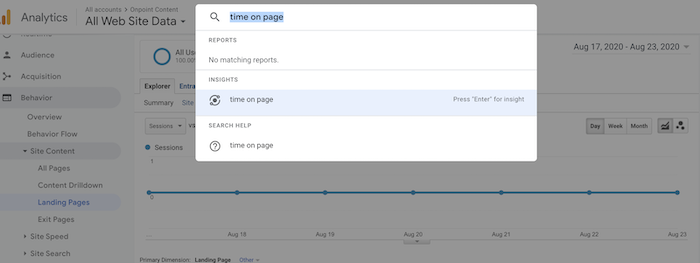
The time on the page is based on two clicks:
1. A user visits your website.
2. The user then clicks another page on your website.
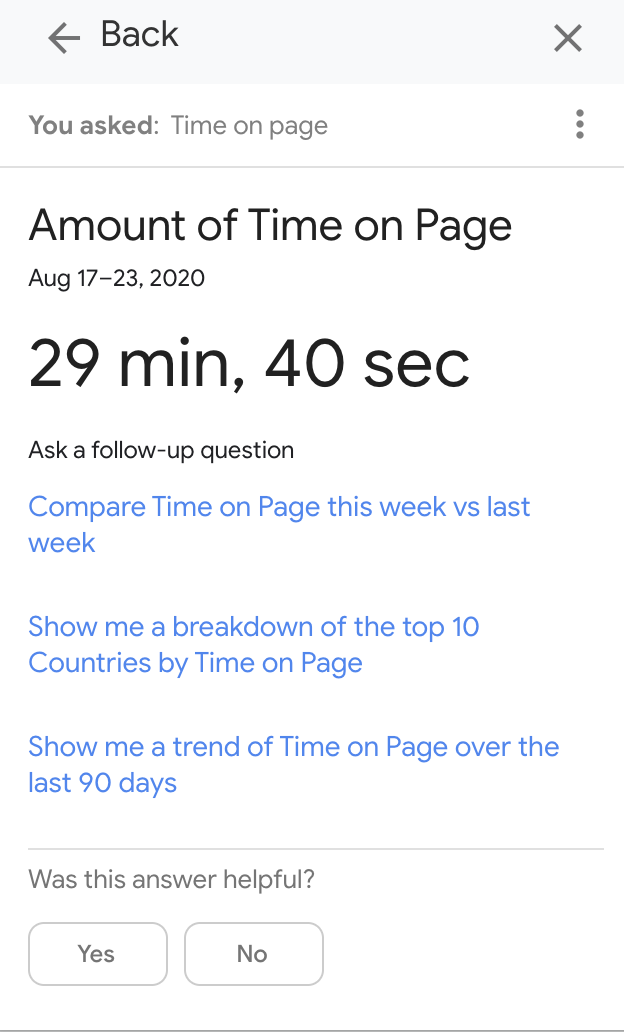
The big difference between time on the page and dwell time is whether or not the visitor visited another page on your website. Over time on the page, they will need to visit a second page on your website for Google Analytics to take the session into account.
If a user visits only one page of your website, Google Analytics shows the time on the page for the session as zero.
Here are 11 strategies to increase the dwell time of your pages.
Hook reader on
You have a chance to make a good first impression of the SERP. A web usability study found that the first 10 seconds of a page visit are crucial for whether a visitor stays or leaves.
Are your blog post introductions very popular with readers? To encourage retention time, each introduction needs to be interesting and relevant to your target keywords.
Take this example from a recent post on spying on your competitor's SEO.
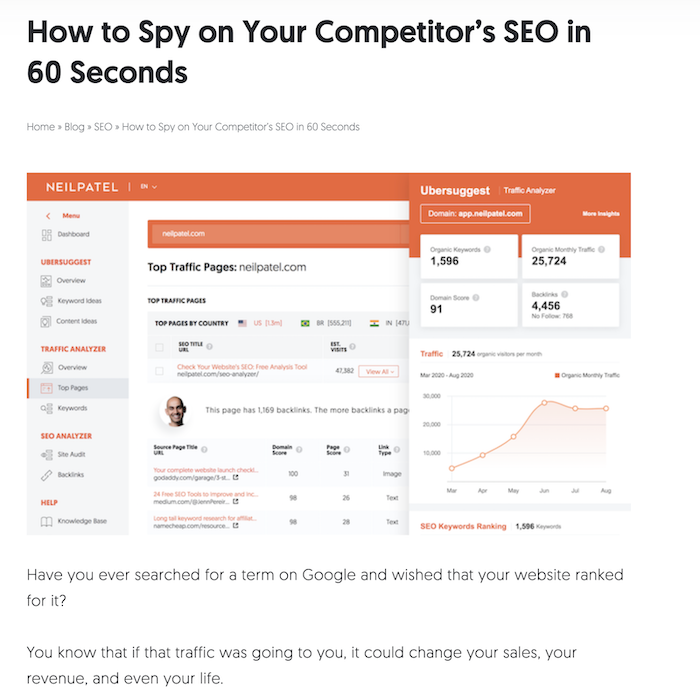
The open question is the catch. The following sentence is short and touches a universal pain point. It also serves as a transition that leads the reader to the thesis.
That catch isn't like a traditional thesis, however. It's a taste of what readers can expect from your article.
Divide into snack sections
Its introduction gets the site visitors to read on.
Use H2 to break content into sections so that you can read it easily. It also makes it easier for people to go back later and refer to your content.
A good example is this article on defining your target audience.
Another way to make your content easier to use is to convert concise lists into bullet-pointed format. These make content easier to read and help users find the meat of the content faster.
Another way to motivate readers is to use loads of screenshots and other visuals to illustrate your points.
Create a multimedia experience
Infographics aren't just for referral traffic. Visuals can also help motivate your website visitors.
For example, check out this content layering infographic. It makes a complex topic easier to digest and understand.
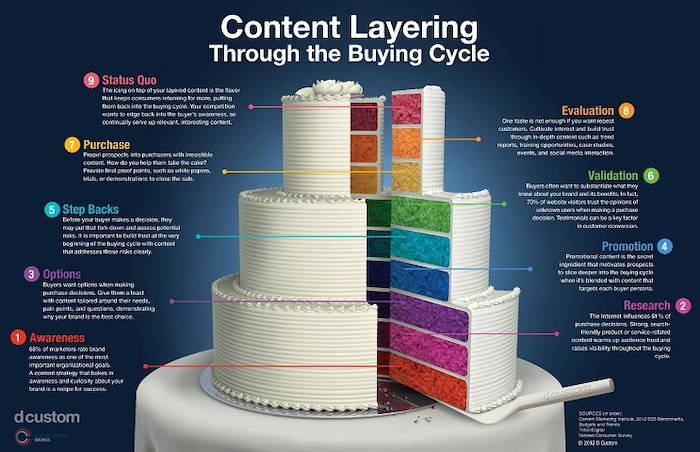 Image source
Here are some tools you can use to quickly create graphics for your content:
Video can also encourage visitors to stay here. 80% of marketers stated in a Wyzowl survey video that they increase the time they spend on their website. Embedding videos in your content is also possible.
Here are a few different strategies for making video more effective:
- Use an eye-catching video thumbnail for users to click and watch.
- Customer testimonial videos and product videos can be a powerful way to drive conversions.
- Embed a video explaining a specific strategy or concept that you address in your content. Use the video to delve deeper into the strategy.
- Share a video from a popular YouTube channel in your content. Then contact the producers as there may be opportunities for social referral traffic.
- Include a video that contains information with related content.
Match search intent
If you're looking for # 1 for a keyword on Google, you have to be the most relevant query. In other words, the content of your page must reflect a searcher's intent, the reason for the search.
Let's say you're trying to qualify for "Best Spa" in NYC.
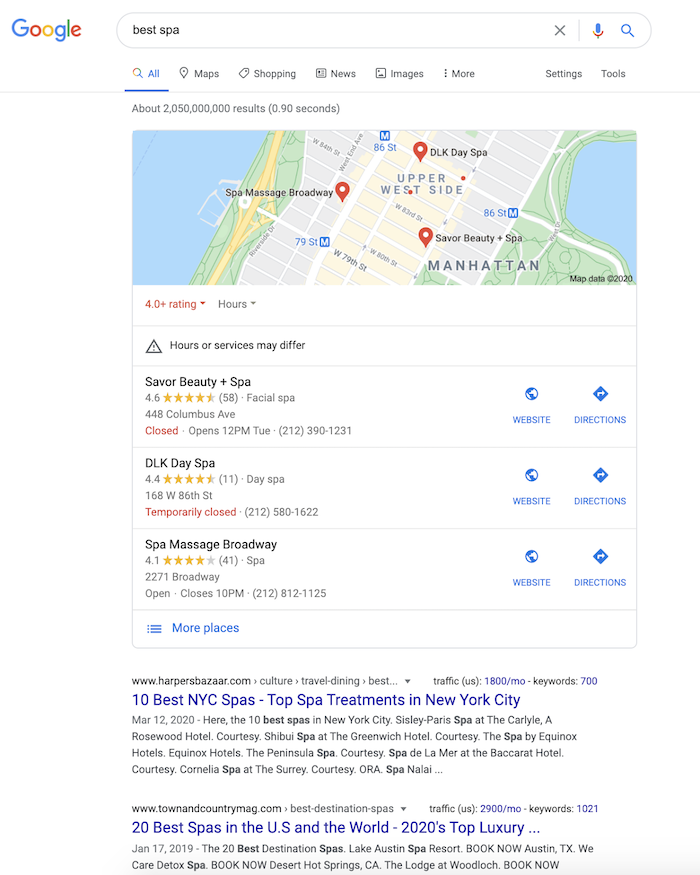
Google knows the most relevant results from millions of searchers who either jumped around on pages. In this case, spa options are the best results based on a seeker's location and the best spas in the world.
A landing page highlighting a specific spa doesn't work. However, diagrams showing the various amenities of the destination spa and price comparison tools can be effective.
The four most common types of search intent are:
information
A seeker looks for general information (“How can I interpret my dreams?”) Or for an answer to a specific question (“How old is Elon Musk?”).
Other examples of information search:
- "When is NBA Draft"
- "LAX Terminal 4 to 5 directions"
- "Howard Schultz"
brand
The searcher is looking for a specific website or brand. They may forget the url or find it easier to google a brand than enter the website address.
Examples of trademark searches:
- "Instagram Login"
- "Ubersuggest"
- "Neil Patel's Guide to Local SEO"
inquiry
When a search query is made, a searcher shows interest in an article or solution, but continues to research and compare its options.
Examples of search queries:
- "Best Spas"
- "United versus Delta"
- "Ubersuggest Reviews"
transaction
With a transaction search, the searcher is ready to buy. They are either looking for the best price or trying to find a specific item or service.
Examples of transaction searches:
- "Chipotles near me"
- "Buy iPad Pro"
- "Athletic Greens Coupon"
Now let's assume that a spa opts for corporate wellness retreats. Here are the steps you can take to conduct competitive research on Ubersuggest:
First, check the search volume and keyword difficulty under Keyword Ideas.
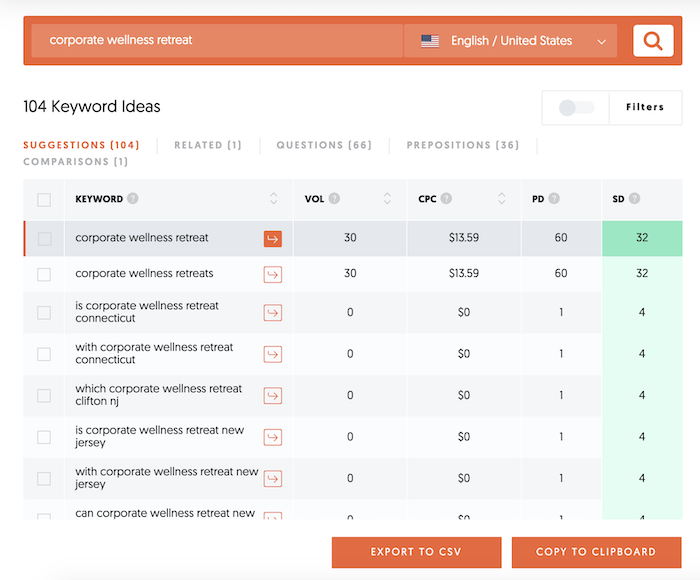
Next, analyze the best SERP results for this keyword.
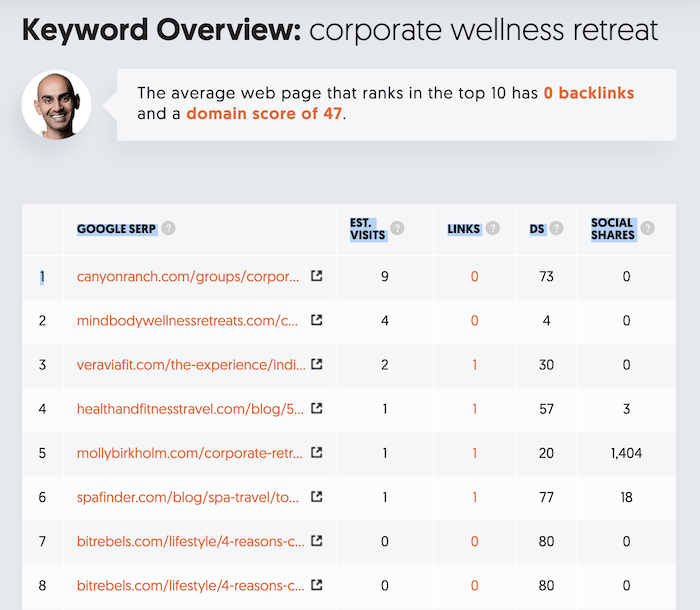
Are the best performing product pages, blog posts, or some other format? When we did a search for “Corporate Wellness Retreat,” we saw that most of the top 10 results were landing pages.
As you review each page, take notes on the content of the page to see how you can improve.
You can also check on-page optimizations such as: For example, the use of keywords in headings and sub-headings, and other factors that promote dwell time.
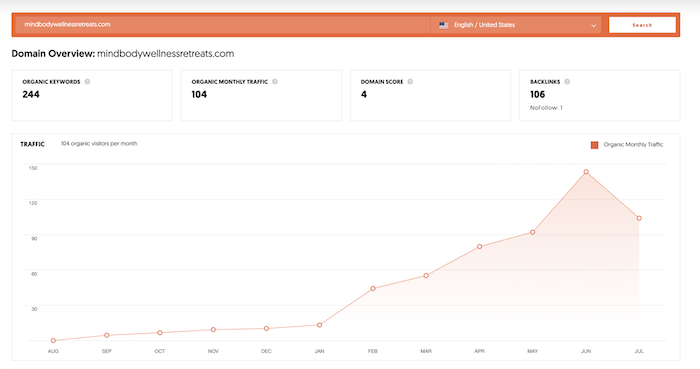
Then check out the top results of the off-page SEO strategy. Copy the URL of a result in Ubersuggest and select Overview to learn more about the domain, including:
- The number of backlinks pointing to your domain
- Domain score; The higher the number, the more authoritative a website is and the higher its rank in Google
- The number of unique domains that are re-linked to your domain
Create in-depth content
In most cases, longer content will get more traffic. Because it takes longer to read, more robust content increases the retention time.
Help visitors hold up by providing the resource for a specific query using the skyscraper technique (a term originally coined by Brian Dean of Backlinko).
All skyscraper content contains one or more of the following:
- Useful: If possible, does it include step-by-step instructions? Do you offer your readers clear takeaways?
- Entertaining: Does your content attract your reader through either a compelling narrative, hook, or funny bits and pieces?
- User experience: Is your content easy to navigate and skim? Does the content flow logically? Is the content accessible in tone and style? In particular, it doesn't read like a doctoral thesis or use larger words than necessary.
Each of the eight steps in this article on how to monetize your blog shows that you don't need a lot of traffic to make money. Readers can also see a ton of examples that they can look to for inspiration.
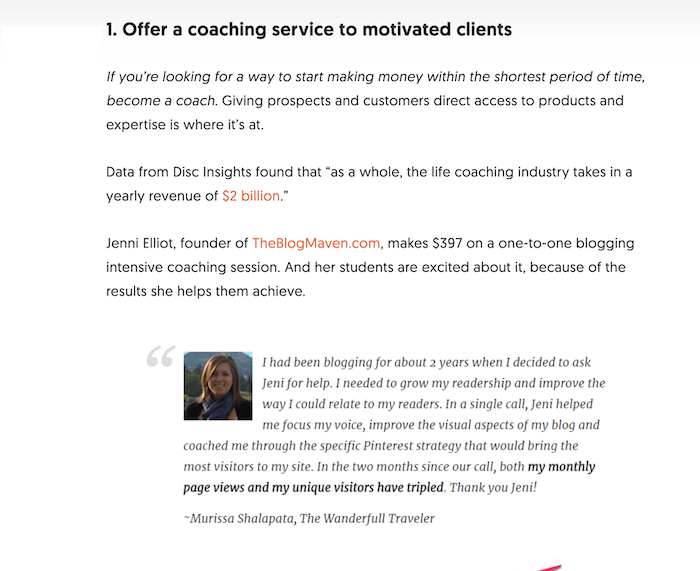
By producing in-depth content, it ranks # 1 on highly competitive keywords and readers spend an average of over 4 minutes on the page.
Activate comments
Open your blog for questions and discussion in the comments. Just like here where I try to reply to any comments.
People want to read other people's comments. Other readers are likely to have the same questions and may include additional valuable answers from the author.
When people read or add their own comments, their dwell time increases.
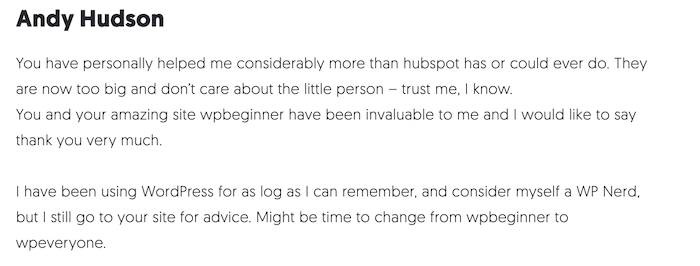
Plus, you can get a lot of great feedback with your website visitors, like in the comment below.
Create interactive elements
Not only does interactive content keep users on your site longer, but it can also improve the user experience.
Quizzes, polls, downloadable reviews, and calculators are features that website visitors can use to solve the specific problem they solved on your website.
Determine the next steps
If someone wants to learn more about a specific topic you've covered, make it easy to access via an internal link.
Internal links not only help keep users on your website, but they are another important feature for on-page optimization.
Your internal links can also lead users to take the next step down your inbound funnel.
As you may know, a column page is a central element on a website that goes into depth on a topic.
For example, let's say you want to pick a keyword with a significant volume, like "Camper Living".

Once you've created a column page targeting the keyword, it's time to create a blog post reviewing an RV like a mobile hotspot. Then link to this piece on this pillar page.
Increase the speed of your website
To make a great first impression and prevent people from clicking the back button on your site, you need to make sure your pages load quickly.
47% of consumers expect a page to load in two seconds or less.
Some tools to speed up your website:
Mobile first
More than half of the world's traffic comes from mobile devices. This means that you need to have a mobile-first experience on your website.
What does that mean? Your website needs to perform well on mobile devices, not just on the desktop.
To check that your pages are mobile-friendly:
- Visit the Google Search Console.
- Click on "Mobile Usability".
- If you see errors in the Search Console, click the error to view details on how to fix the problem on your website.
The Google support documentation linked in the results also contains more information about specific errors.
Level up the copy
You can have the best content but still not get a response from your readers.
Are all sentences in your content the same length? Do paragraphs start the same way? It's getting boring.
Copywriting techniques are the be-all and end-all up your sleeve. Here are some strategies to keep your writing engaging that copy masters can adopt:
Just do it. Make it memorable. Make it inviting to look at. Make it fun to read.
-Leo Burnett
Can you say the same thing in fewer words? Are their compelling stories or stats that you can use to draw a reader in?
Copying is a direct conversation with the consumer.
– Shirley Polykoff
Keep the conversation going by mirroring your customers. Not sure what your audience is thinking? Interview your current and existing customers.
Do you have sections where readers may be overwhelmed or bored? Use Bucket Brigades, a term composed by Brian Dean. These sentences help bridge two sentences and guide the reader through the content.
These phrases are instant attention grabbers and keep readers from hopping:
- Pro tip:
- This is the deal:
- Now:
- What's the bottom line?
- You may be wondering:
- That's crazy:
- It gets better / worse:
- But here's the kicker:
- Do you want to know the best?
Conclusion
All of these techniques can help increase residence time. However, let your rankings and analysis reveal the most effective elements for your content. Start at the top of the list and try each strategy out. For example, you may find that your users respond to interactive elements or prefer lists.
Once you see what works, you can tweak your strategy.
What strategy will you try first?