
The facility of storytelling
A good story brings ideas to life and inspires listeners to introduce themselves in the storyteller's position as events unfold and lessons learned. The vicarious experiences the audience has while hearing stories can create an emotional connection – – Sensory details, actions and language that are part of a good story make the message memorable and impactful.
For leaders and communicators, storytelling is an important tool in our communication arsenal when we need to influence, teach, and inspire people to take action. Research by well-known cognitive psychologist Jerome Bruner found that facts are 22 times more likely to be remembered when told in a story.
What makes a great story?
When creating a story, you want it to inspire and engage the audience, help them gain new perspectives, and make connections that give meaning to the circumstances or information. Whatever your end goal, an effective story should be:
- Simple, easy to say, and easy to remember – We want to get involved quickly and break through the noise.
- Short and to the point – With so many sources of information bombarding us at any given time, the average attention span for a person is only about eight seconds. This doesn't mean your stories need to be told in less than 10 seconds, but is a great reminder to keep your stories short in order to get your listeners' attention.
- Determined and honest – Tie the story to the end result you want to achieve by highlighting problems and showing how they were overcome.
- Repeated – In order to expand the audience and the reach of the message, you want to keep telling your story and inspire others to repeat it.
But how do stories we use in the workplace differ from those we tell while barbecuing in the garden? The main difference is that the story in the workplace has a moral or purpose. It has a punch line that helps an employee know what's important and links the story to a desired behavior or outcome.
When writing a story to strengthen a workplace goal, we recommend using a standard formula:
Context + characters + conflict + morality = Your story
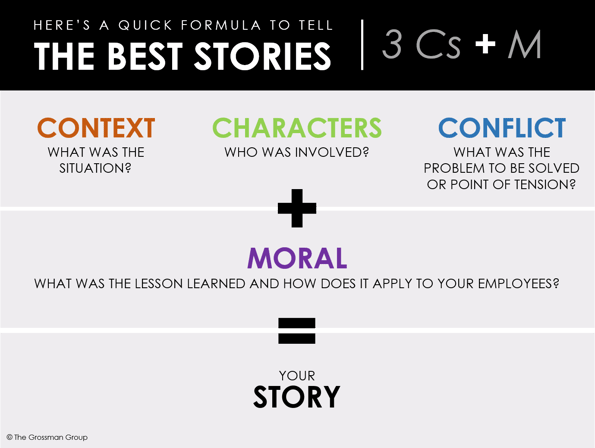
See if you can find these key elements in this sample story:
“My wife and I are working on a home remodeling project that is one that we believed had great potential. After we bought it, we quickly realized that it meant more work than we thought. In fact, we had to tear it down down to the tunnels and rebuild it. The whole experience reminds me of our work in the consumer-centric business. It's like a house in need of remodeling that was wonderful in its prime and is now suffering from delayed maintenance. But when we're done we know it will be profitable, and just as important is that we are comfortable working together. The key is that we are all in it together. "
The context – Having a home project that requires more work than you thought it would be – is accessible to the public on both a personal and professional level. The character – the speaker and his / her wife – stand in front of the conflict having to do more than they expected to get the job done. At the end of the day the moral or one lesson that applies to the staff audience is that the extra work will produce positive results and "we are all together on this".
Storytelling for executives
Executives use stories to advance various goals in their organization, from helping employees connect with the strategy and understanding success using a real-world example, to explaining their future vision for business transformation and building trust through the Sharing your personal challenges and experiences.
In fact, we encourage leaders to build a library of short stories based on their own experiences that they can use to highlight key messages, explain values, or reinforce key behaviors.
One of our clients inspires her employees with stories about "the value of hard work" (a lesson she learned in her early years), "the importance of accepting differences" (a personal value that develops throughout her life in different countries has) and "the power of focus and alignment" (an attribute of corporate culture that she believes is critical to its success). Use this approach to develop your own library of great stories with morals to incorporate into your communication.
What employees want to know about their managers
As you develop stories that resonate and drive your goals, it helps to consider and find answers to the most common questions that employees ask their leaders. I've listed a few topics and questions below to get you started.
Questions about you:
It's not just about the organization, people want to know who you are, what's important to you and how it could affect them, and have questions like:
- How did you get to where you are
- How are people supposed to get to know you? What makes you tick
- What do you expect from the employees?
- What should they expect from you?
- What do you want to get involved in?
Questions about the organization and its goals:
Executives are the primary source of information about the company, its goals, and the way employees connect with the bigger picture.
Creating stories that resonate can help increase employee understanding of issues such as:
- What is your vision What should different audiences believe in you and the vision?
- Who are we and what are we doing?
- What are our business goals and strategies?
- What initiatives will drive the business today? In the future?
- What are the new behaviors that you expect employees to work successfully to get your results? How are we going to get the results we need?
- What does success look like?
- How will we measure success?
- What needs to be changed to achieve this?
Put the parts together
What you're saying is part of a larger internal communication burden that includes how and when employees get the message. Storytelling needs to be strategy based and part of a larger plan. For example, when we are outlining a company's strategy or a leader's vision on a news platform, we develop news and support points to improve desired audience perception and overall strategy. When this critical information is defined and verified, the stories that make the news personal and compelling are created and woven into the mix.
Storytelling can be a powerful way to support learning, inspire employees to act, and help them connect with what matters.
What morals are important for your staff to know through stories and what key lessons can you share in building your story library?
– David Grossman
Wouldn't it be helpful to have all of your core messages and story library in one place for quick access and communication when you need to? Whether it's complex, important messages or stories that need to be shared in order to create emotional connections with your employees, the Leadercommunicator platform is an indispensable tool for leaders.